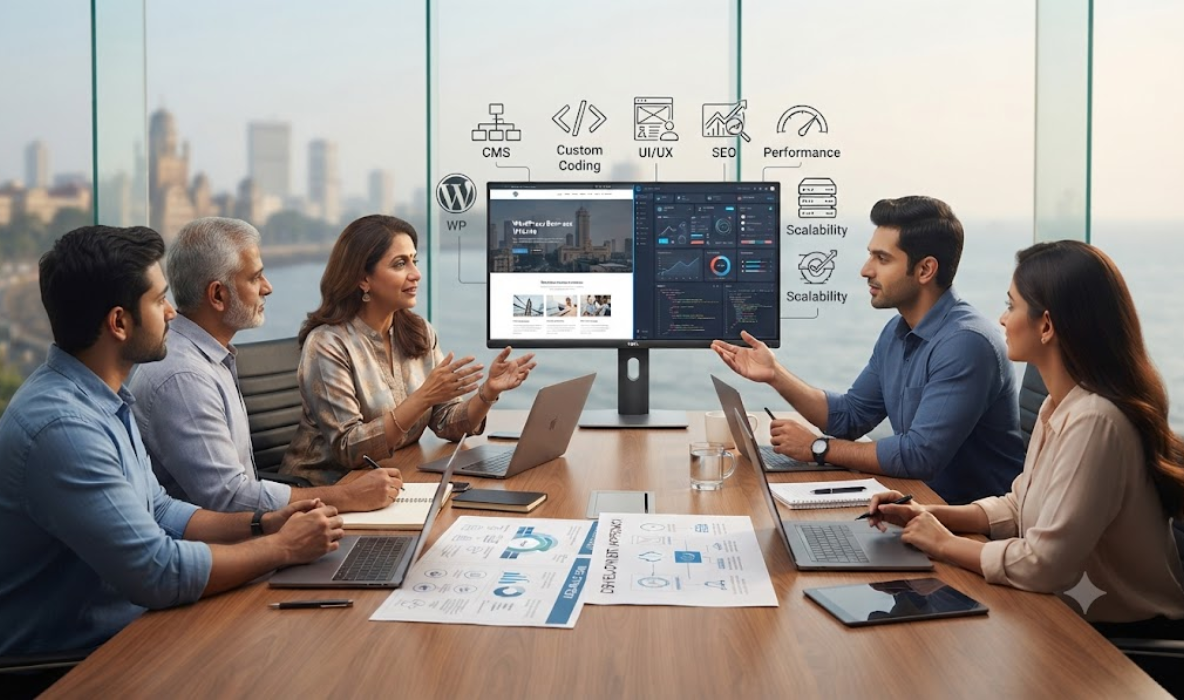
Custom Website Development vs WordPress: Why the Choice Matters
When starting a new website, one of the most important decisions a business needs to make is choosing the right development approach.
Should you build the website using WordPress, or should you invest in custom website development?
There is no universal answer.
WordPress is an open-source content management system designed to make publishing and website management accessible while still allowing developers to extend it with themes, plugins and custom code. WordPress itself describes the platform as flexible enough for everything from simple websites to complex portals and applications.
Custom website development takes a different approach. Instead of starting with a general-purpose CMS and extending it, developers create functionality and interfaces specifically around the business requirements.
The difference can be compared to:
WordPress: Start with a flexible foundation and customize it.
Custom Development: Build the foundation around the specific requirements.
For many businesses, WordPress can provide everything they need without unnecessary development complexity.
For others, specific workflows, integrations, dashboards or business logic may justify a custom solution.
The decision should therefore be based on factors such as:
- Business requirements
- Website functionality
- Budget
- Design requirements
- SEO needs
- Performance
- Scalability
The goal is not simply to select the more technically complex option.
The goal is to select the approach that solves the business problem efficiently.
What Is WordPress Website Development?
WordPress website development involves creating a website using WordPress as the underlying content management system.
WordPress is open-source and provides a combination of content management, themes, plugins, user management, publishing tools and developer APIs. Its official documentation highlights its flexibility, extensibility and ability to support different types of websites.
A WordPress website can be built using:
- Ready-made themes
- Premium themes
- Custom themes
- Elementor or other visual builders
- Custom plugins
- Third-party plugins
- Custom PHP development
This means WordPress is not limited to basic blogs.
A professional WordPress website can include advanced functionality when properly developed.
For example, a business could use WordPress for:
- Corporate websites
- Service-based businesses
- Portfolio websites
- News and publishing websites
- Educational websites
- Membership websites
- Healthcare websites
WooCommerce can also turn WordPress into a highly customizable e-commerce platform. WooCommerce describes itself as an open-source commerce platform for WordPress, with extensive customization and extension options.
The biggest advantage is that businesses do not always need to develop every website function from zero.
They can start with existing functionality and customize the website according to their requirements.
What Is Custom Website Development?
Custom website development means creating a website or web application specifically around the requirements of a business.
Instead of depending primarily on pre-built themes and plugins, developers can create custom:
- Front-end interfaces
- Back-end systems
- Databases
- User dashboards
- Business logic
- APIs
- Authentication systems
- Booking workflows
For example, imagine a business that needs a customer portal where users can:
- Create an account
- Submit documents
- Track applications
- Make payments
- Receive notifications
- View personalized reports
- Communicate with staff
A WordPress solution may be able to handle some or all of these requirements through plugins and custom development.
However, if the business process is highly specialized, a custom web application may provide a more controlled architecture.
Custom development is particularly relevant when the website is not simply an informational website but is actually part of the company’s operational system.

Custom Website vs WordPress: Major Differences
WordPress is designed to be extensible. Its official documentation notes that themes, plugins, APIs and custom content types allow developers to extend the platform significantly.
Custom development provides greater control over the technical architecture because the system can be designed around the specific application.
However, greater control also means greater responsibility.
A custom website usually requires a stronger development process, more testing and ongoing technical support.
Therefore, “custom” should not automatically be interpreted as “better.”
The appropriate option depends on what the business actually needs.
Cost Comparison: WordPress vs Custom Website Development
Cost is one of the most important differences businesses consider.
In general, WordPress can reduce development costs because businesses can use an existing CMS, themes, plugins and established development tools.
A basic WordPress website can therefore be developed within a relatively modest budget.
A custom website generally requires more design, development, testing and technical planning.
Indicative Planning Ranges
Basic WordPress Website:
₹20,000–₹50,000+
Professional WordPress Website:
₹50,000–₹1.5 lakh+
Custom WordPress Website:
₹75,000–₹3 lakh+
Custom Business Website:
₹75,000–₹3 lakh+
Custom E-commerce Website:
₹2 lakh–₹10 lakh+
Custom Web Application:
₹2.5 lakh–₹15 lakh+
Advanced SaaS / Enterprise Platform:
₹5 lakh–₹35 lakh+
These are broad planning ranges rather than fixed industry prices.
Design and Customization: Which Gives You More Control?
Design is often where businesses notice the difference between a standard WordPress website and a custom-built website.
WordPress provides themes and flexible design tools, but the final level of customization depends on how the website is developed.
A WordPress website can have:
- Custom homepage
- Custom headers
- Custom footers
- Custom layouts
- Brand-specific colors
- Custom typography
- Custom sections
- Custom animations
With a skilled WordPress developer, the website does not necessarily have to look like a standard template.
Custom development can provide even more control because the interface can be designed specifically around the business.
For example, a custom application may require a unique dashboard where different users see completely different interfaces based on their roles.
This type of interface can be developed from the ground up.
SEO and Performance: WordPress vs Custom Development
SEO is not automatically better on one platform simply because it is WordPress or custom-built.
Search performance depends on how the website is designed, developed and maintained.
Google’s Search guidance emphasizes technical accessibility, useful content, mobile usability, performance and other best practices rather than requiring a particular CMS.
A WordPress website can be highly SEO-friendly when it has:
- Clean URL structure
- Proper heading hierarchy
- Optimized images
- Good internal linking
- Fast loading pages
- Mobile-friendly layouts
- Structured data where appropriate
- Search Console configuration
Custom websites can also be optimized for SEO.
However, SEO problems can occur if developers create:
- Poor URL structures
- JavaScript-heavy content that is difficult to process
- Slow pages
- Duplicate pages
- Missing metadata
- Poor internal linking
- Unoptimized images
- Incorrect redirects
Performance should therefore be treated as a development requirement rather than a platform label.
For WordPress, developers also need to manage themes, plugins, scripts, hosting and database performance.
For custom development, developers have more control over the architecture but are responsible for building and optimizing those systems themselves.
The right question is not:
“Is WordPress better for SEO?”
Instead ask:
“Will the development approach produce a technically sound, fast, crawlable and useful website?”
Security and Maintenance: WordPress vs Custom Website
Security is important for both WordPress and custom websites.
WordPress is widely used and has a large ecosystem of themes and plugins.
That ecosystem provides flexibility, but it also means websites need regular maintenance.
WordPress websites should be maintained through:
- Core updates
- Plugin updates
- Theme updates
- Security monitoring
- Backups
- User-access management
- Malware monitoring
- SSL configuration
A poorly maintained WordPress website can develop compatibility or security problems.
Custom websites have a different maintenance model.
Scalability: Which Approach Is Better for a Growing Business?
Scalability means the website can continue supporting the business as requirements grow.
A common misconception is that WordPress is only suitable for small websites.
WordPress itself states that the platform can support everything from simple websites to complex portals, enterprise websites and applications.
WooCommerce also positions its open-source platform as flexible and scalable for different types of commerce.
A well-built WordPress website can therefore grow with:
- Better hosting
- Caching
- CDN
- Database optimization
- Custom development
- Plugin optimization
- Custom themes
- WooCommerce
However, there can be a point where a business has requirements that are better served by a custom application architecture.
For example:
A company may start with WordPress for marketing content.
Later, it may develop a separate custom customer portal.
Another business may begin with WooCommerce and eventually require custom inventory, ERP and B2B workflows.
This does not mean the original platform was a mistake.
Technology requirements can change as the business evolves.
Which Businesses Should Choose WordPress?
WordPress can be a practical choice for businesses that need a professional website without developing every feature from scratch.
It is particularly suitable when the website’s primary purpose is communication, content publishing, lead generation or standard e-commerce.
WordPress May Be Suitable For:
1. Local Businesses
Restaurants, clinics, salons, consultants, retailers and local service providers can use WordPress for professional online presence and lead generation.
2. Professional Service Businesses
Law firms, architects, agencies, financial professionals, consultants and other service businesses can manage service pages, blogs and enquiries.
3. Corporate Websites
Companies can use custom WordPress designs for company information, services, industries, case studies, careers and content.
4. Content-Driven Businesses
Publishers, educational businesses and organizations can benefit from WordPress’s content management capabilities.
5. E-commerce Businesses
WooCommerce can provide a flexible commerce solution for businesses that need control over their store and website environment.
6. Businesses With Frequent Content Updates
Marketing teams can manage pages, posts and media without requiring developers for every small content change.
7. Businesses With Moderate Customization Requirements
If the website requires customization but does not need a completely unique application architecture, WordPress can be an efficient option.
The main advantage is that businesses can combine an established CMS with custom design and development.
Conclusion: WordPress or Custom Website Development?
The question “Custom Website Development vs WordPress: Which Is Better?” does not have one universal answer.
WordPress is a flexible open-source platform that can support everything from small business websites to complex websites and applications. Its themes, plugins and developer tools allow businesses to build highly customized websites without creating every component from scratch.
Custom website development provides greater control over the application’s architecture, workflows and functionality.
For a standard business website, professional corporate website, blog, lead-generation website or many e-commerce projects, WordPress can provide a practical foundation.
For SaaS platforms, complex portals, marketplaces, specialized business applications and highly customized workflows, custom development may be more appropriate.
The decision should therefore be based on:
Business requirements + functionality + budget + scalability + maintenance
Rather than asking:
“Which technology is better?”
Ask:
“Which technology is appropriate for my business requirements?”
A professional website development company can help translate your requirements into the appropriate technical approach, whether that means WordPress, WooCommerce, custom WordPress development or a completely custom web application.
For businesses looking for website development in Mumbai, the first step should be defining the website’s purpose, required functionality and expected growth. Once those requirements are clear, the technology decision becomes much easier.