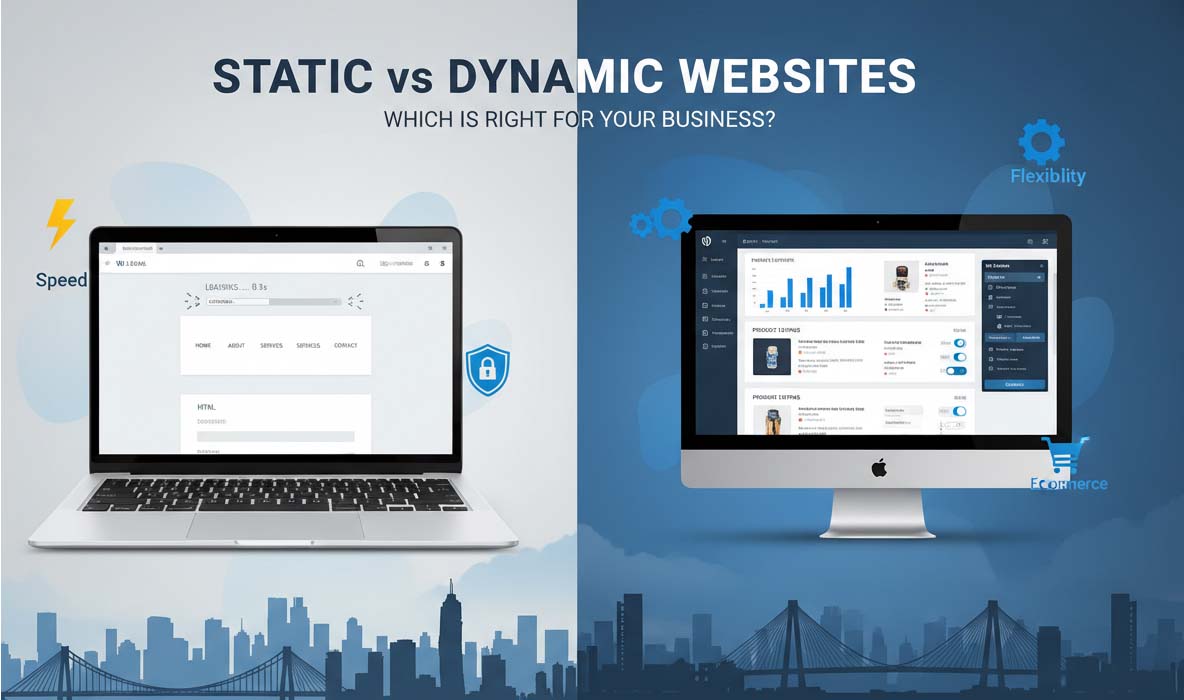
Static vs Dynamic Website
Static vs Dynamic Website
Static vs Dynamic Website: In 2026, a website is no longer just a digital visiting card. It is a sales engine, brand identity platform, customer service tool, and data collection system — all in one. With rapid technological advancements, AI-driven systems, evolving search engine algorithms, and increasing cybersecurity threats, building a website without proper planning can result in wasted investment. Website Designer in Mumbai
Choosing the right website designer in Mumbai is important for your business. A well-designed website not only improves branding but also increases conversions. If you’re looking for expert help, explore our Website Development Services to understand how we build high-performing websites.
If you're a Mumbai business owner trying to decide between a static and dynamic website - this is the most important thing you'll read before you make that decision.
Let’s be honest about something first.
Most of the content you’ll find online about static versus dynamic websites was written by people who have never run a business in Mumbai, never tried to compete for customers in Andheri East’s pharmaceutical corridor, never tried to build a restaurant brand in Bandra’s ferociously competitive dining market, never tried to establish a professional services practice in the shadow of Lower Parel’s corporate towers, and never tried to grow a retail business while competing with every other shop on Linking Road for the attention of the same consumer base.
The generic advice – “static websites are faster, dynamic websites are more flexible, choose based on your needs” – is not wrong, exactly. It is just so abstract and so removed from the commercial realities of running an actual business in an actual competitive market that it fails to help the people who most need the answer.
This post is different. We are a web development company based in Borivali West, Mumbai. We have built websites for businesses across the Western suburbs, the Central line corridor, South Mumbai, Navi Mumbai, and every major commercial zone in the city. We have seen, from direct experience working with real Mumbai businesses, exactly what the static versus dynamic decision means in practice – what it costs, what it produces, what it enables, and what it limits. And we are going to tell you everything we know about it.
By the time you finish reading this, you will know – with genuine clarity – which type of website is right for your Mumbai business, why, and what to do next.
First: What Actually Is a Static Website?
The word “static” sometimes puts people off. It sounds old-fashioned. It sounds limited. It sounds like the opposite of what a modern, growing, competitive business should want.
None of those associations are accurate, and the first thing we need to do is clear them up.
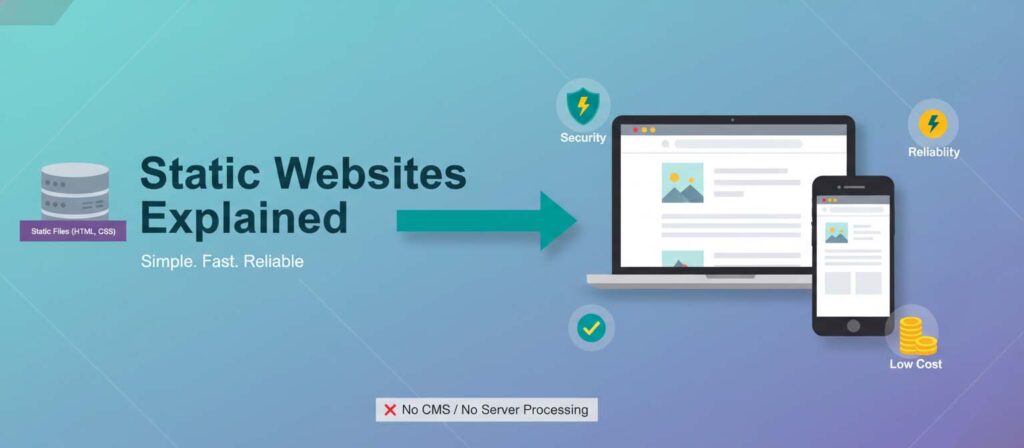
A static website is, at its most fundamental level, a website where each page is a fixed file – written in HTML and CSS – that is delivered to the user’s browser exactly as it is stored on the server. There is no database being queried, no server-side processing happening, no content being assembled on the fly from multiple sources. When someone visits a static website, their browser receives a pre-built page, renders it, and displays it. That is the entire transaction.
What this means in practice:
Static websites are, almost without exception, the fastest type of website available. Because there is no server-side processing between the request and the response, page load times are minimal. For a city like Mumbai – where mobile internet speeds vary enormously across suburbs, where 4G connections are often the primary internet access mechanism for a significant proportion of potential customers, and where Google’s Core Web Vitals performance metrics directly influence search rankings – this speed advantage is not a minor technical nicety. It is a genuine commercial differentiator.
Static websites have a dramatically smaller attack surface than their dynamic counterparts. There is no database to be compromised, no login portal for malicious actors to target, no content management system with security vulnerabilities to exploit. For businesses handling sensitive client information – healthcare providers, legal practices, financial advisors – this security advantage is commercially significant.
Static websites almost never go down due to technical failures. There are no complex systems that can malfunction, no database connections that can time out, no server-side processes that can crash under load. This reliability is particularly valuable for businesses whose website is a primary mechanism for client contact and commercial credibility.
Static websites are generally less expensive to build, less expensive to host, and less expensive to maintain than equivalent dynamic websites. For businesses with straightforward digital requirements, this cost advantage makes static development a genuinely attractive option.
What static websites do not offer, by definition, is the ability to update content through a visual interface without touching code. Every change to a static website – every updated service description, every new team member added, every pricing change – requires a developer to edit the underlying files and redeploy the site. For businesses that need to make frequent content changes, or that want the independence to manage their own website without ongoing developer involvement, this limitation is commercially important.
And What Is a Dynamic Website?
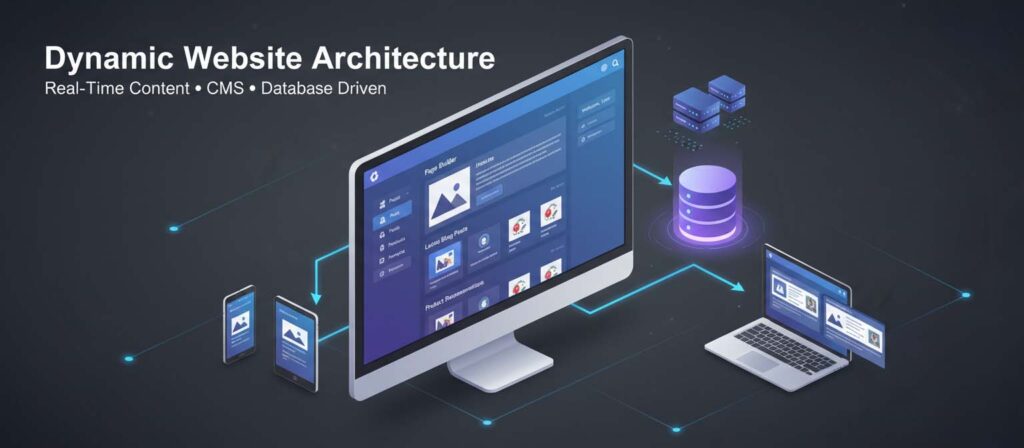
A dynamic website is one where the page content is assembled in real time when a user makes a request – drawing from a database, processing through server-side logic, and delivering a page that is built specifically for that user’s request at that moment.
When you visit a website and see your name displayed after logging in, that is dynamic functionality. When a restaurant website shows you a menu that the owner can update from a back-end dashboard without touching any code, that is dynamic functionality. When an eCommerce store shows you product recommendations based on your browsing history, that is dynamic functionality. When a coaching institute’s website displays the current batch schedule, pulled from a database that the admin team updates regularly, that is dynamic functionality.
The most common dynamic website platform in the world is WordPress – which powers approximately 43 percent of all websites on the internet, including the majority of business websites built professionally. WordPress is a Content Management System, or CMS – a platform that allows non-technical users to log in through a browser interface, make content changes, add pages, update products, publish blog posts, and manage virtually every aspect of their website’s content without writing a single line of code.
Other dynamic website approaches include custom-built platforms on frameworks like PHP and Laravel, React-based websites with headless CMS backends, and various other technical architectures that share the core characteristic of server-side processing and database-driven content delivery.
What dynamic websites offer, over and above static websites:
The business owner or their marketing team can update the website at any time, without developer involvement, through a visual interface. For businesses with regularly changing content – restaurants updating menus, coaching institutes updating batch schedules, real estate businesses updating property listings, eCommerce businesses updating product catalogues – this independence is not just convenient but commercially essential.
Dynamic websites can accommodate any level of functional complexity – from simple CMS-managed content to sophisticated eCommerce platforms, booking systems, client portals, multi-user workflows, and custom applications. Static websites have hard functional limits. Dynamic websites, properly built, do not.
Dynamic websites can respond to user behaviour, manage user accounts, process transactions, handle forms and inquiries in sophisticated ways, and deliver personalised experiences. Static websites cannot do any of these things natively.
An online store – one that manages product catalogues, shopping carts, payment processing, order management, and customer accounts – is by definition a dynamic website. There is no static equivalent for genuine eCommerce functionality.
The trade-offs of dynamic websites, compared to static ones:
Dynamic websites are inherently slower than static ones, because of the server-side processing involved in assembling each page. This performance gap can be substantially closed through good technical implementation – caching, content delivery networks, performance optimisation – but it cannot be entirely eliminated. A poorly built dynamic website will always be slower than a well-built static one.
Dynamic websites – and particularly WordPress websites – are frequent targets for malicious attacks because of their enormous market prevalence. A dynamic website that is not properly maintained and security-hardened carries real and ongoing security risk. This risk is manageable through correct hosting, regular updates, and proper security configuration – but it is a genuine ongoing responsibility that static websites simply do not have.
Dynamic websites cost more to build, more to host on adequate infrastructure, and more to maintain properly than equivalent static websites. For businesses with straightforward requirements, this additional cost needs to be justified by the additional capability that the dynamic platform provides.
The Mumbai Context: Why This Decision Is Different Here

Here is where most generic guides on this topic go wrong. They describe the technical trade-offs accurately enough – but they describe them in a vacuum, without any reference to the specific commercial and competitive context in which a business is actually making the decision.
Mumbai is not a vacuum. It is one of the most commercially specific environments in the world – and the static versus dynamic decision looks different here than it looks in a smaller city, a less competitive market, or a different industry context. There are several factors that are specific to Mumbai’s commercial environment that bear directly on this decision.
In most commercial categories – healthcare, professional services, restaurants, retail, education, real estate, financial services – the businesses competing for Google search visibility in Mumbai are numerous, well-resourced, and increasingly digitally sophisticated. Ranking well in Mumbai’s search market requires not just a technically competent website but a comprehensive SEO strategy – and both static and dynamic websites can be built with strong SEO foundations. However, dynamic websites – and WordPress specifically – make ongoing content creation, blog publishing, and the kind of sustained SEO activity that builds search authority over time significantly more accessible to the business owner. In Mumbai’s competitive search landscape, this content accessibility is a meaningful strategic advantage.
Mumbai contains multitudes. The technology startup in Powai with a digital-native founding team, the Udupi restaurant in Matunga with thirty years of community reputation, the garment exporter in the SEEPZ area competing for international B2B clients, the neighbourhood coaching institute in Kandivali building enrollment from a local student catchment, the luxury real estate developer in Juhu targeting ultra-high-net-worth buyers – these businesses have fundamentally different digital requirements, and the static versus dynamic decision lands differently for each of them. There is no single right answer that applies to every Mumbai business, which is exactly why this decision deserves more thought than generic advice allows.
The proportion of Mumbai’s population that uses mobile internet for commercial research and decision-making has grown dramatically over the past five years – and it continues to grow. The demographics that were the last to adopt digital commercial behaviour in Mumbai – older residents, less affluent segments, traditionally relationship-driven commercial categories – are now doing so at accelerating rates. The commercial imperative for professional digital presence has never been stronger for Mumbai businesses across every category.
The majority of web traffic in Mumbai is mobile – delivered over 4G connections of varying quality, on screens of various sizes, to users who have been conditioned by years of smartphone use to expect fast, clean, easily navigable experiences. Both static and dynamic websites can be built to perform excellently on mobile – but the performance advantage of static websites is more pronounced on mobile than on desktop, and Mumbai’s mobile-heavy traffic profile amplifies that advantage for businesses where speed and performance are the decisive factors.
So: Static or Dynamic? The Mumbai Business-by-Business Answer

Let us now do what no generic guide does – let us work through this decision category by category, for the specific types of businesses that make up Mumbai’s commercial community, and give you a direct and honest recommendation for each.
Independent Professionals and Practitioners
Doctors, dentists, specialists, lawyers, chartered accountants, architects, interior designers, financial advisors, management consultants, nutritionists, physiotherapists, and the full range of qualified practitioners with independent practices across Mumbai’s suburbs.
Here is why. An independent practitioner in Mumbai does not need a website that they update frequently. They need a website that communicates their expertise, their qualifications, their services, and their location clearly and authoritatively – and that makes it effortlessly easy for potential patients or clients to contact them or book an appointment. That requirement is perfectly served by a well-designed, fast-loading static website.
The advantages of static for this category are significant. A static website for a Mumbai doctor or lawyer will load faster – improving both the user experience and the Google search performance. It will be more secure – important for a practice handling sensitive client or patient information. It will cost less to build and maintain – freeing budget for other aspects of practice development. And it will look and perform every bit as professionally as a dynamic website, if it is built to the right design standard.
The only scenario in which we recommend dynamic over static for an independent practitioner is if they intend to actively publish a blog – for example, a specialist physician building thought leadership through regular health content, or a lawyer publishing regular legal updates for their client base. In that case, the content management capability of a dynamic WordPress website is genuinely useful, and the investment is justified. Otherwise, static is the right choice.
Small to Medium-Sized Neighbourhood Businesses
Neighbourhood restaurants, local retail shops, beauty salons, gyms and fitness studios, tutoring businesses, travel agents, small manufacturing units, local service businesses – the backbone of Mumbai’s suburban commercial fabric.
The key factor here is content independence. Most neighbourhood businesses in Mumbai – particularly in the restaurant, retail, fitness, and education categories – need to update their website content with meaningful regularity. A restaurant needs to update its menu when dishes change seasonally, when prices are revised, when the kitchen introduces specials. A fitness studio needs to update its class schedule and membership offerings. A coaching institute needs to update its course list, its batch timings, and its results. A retail business needs to manage its product range.
If these businesses are on static websites, every one of those updates requires a developer’s involvement, a delay, and a cost. Over the course of a year, those costs and delays accumulate – and more importantly, the website falls out of date in ways that damage both its commercial effectiveness and its search performance.
A WordPress website for this category – properly built, properly hosted, and properly set up with a clear and intuitive admin panel – gives the business owner the independence to make these updates themselves, at any time, without any technical knowledge. That independence is worth the additional investment over a static website for most businesses in this category.
The exception is a small neighbourhood business with genuinely static content – a plumber, an electrician, a local professional services firm – whose website is essentially a digital business card that will not require frequent content changes. For these businesses, static is the right and more cost-effective choice.
Restaurants and Food Businesses
Every restaurant, cafe, cloud kitchen, catering business, bakery, and food brand in Mumbai – from the Udupi restaurants of Matunga to the concept cafes of Bandra to the delivery-focused cloud kitchens of Andheri to the premium dining establishments of Juhu.
The restaurant category is one of the clearest cases for dynamic over static in Mumbai’s market. Here is why. A restaurant website is a living commercial document – menus change, prices change, seasonal specials are introduced and retired, events are hosted and promoted, delivery platforms are integrated and updated, photos of new dishes are added, customer reviews need to be managed, and the entire digital presence needs to be kept current to remain commercially effective.
Beyond the content management argument, the restaurant category in Mumbai is one of the most competitive digital search environments in the city. Every suburb has dozens of restaurants competing for the same search queries – “best restaurant in Bandra,” “vegetarian restaurant near me in Matunga,” “South Indian food Santacruz” – and the restaurants that rank well for these searches are consistently the ones with the most content-rich, frequently updated, technically optimized websites. A static restaurant website simply cannot compete in this content-driven SEO environment over the medium term.
For larger restaurant groups, we frequently recommend custom dynamic platforms built on PHP and Laravel – with centralized menu management across multiple locations, integrated reservation systems, and custom ordering functionality that provides a better commercial and brand experience than off-the-shelf plugins can deliver.
Restaurants and Food Businesses
Any Mumbai business selling products online – from fashion boutiques on Linking Road building national eCommerce channels, to garment exporters in the SEEPZ area serving international B2B buyers, to artisan food businesses selling packaged products to the city-wide diaspora, to the full range of product businesses across every category and every suburb.
This is not really a choice. An online store is, by definition, a dynamic website. Product catalogues need to be managed, inventory needs to be tracked, shopping carts need to be maintained, orders need to be processed, customers need to have accounts, and payments need to be securely processed. None of this is possible on a static website.
The real decision for Mumbai eCommerce businesses is not static versus dynamic – it is which dynamic eCommerce platform is right for their specific requirements. For most Mumbai consumer-facing retail businesses, WooCommerce or Shopify is the right answer, with the choice between them depending on the business’s priorities around design flexibility, operational simplicity, and scalability. For B2B and export businesses with trade ordering requirements, custom development on PHP and Laravel is usually the appropriate solution.
What we consistently see in Mumbai’s eCommerce market is the cost of under-investment – businesses that have built cheap, poorly-performing eCommerce websites on inadequate platforms, and that are generating a fraction of the revenue their product range and brand recognition could support on a properly built platform. The investment in a professionally built eCommerce website in Mumbai’s market is not a cost – it is a commercial multiplier.
Corporate Services, B2B, and Technology Businesses
IT services companies, software development firms, management consultancies, HR and recruitment businesses, corporate training providers, logistics companies, pharmaceutical manufacturers, industrial and engineering businesses, financial services firms – the B2B commercial layer of Mumbai’s commercial ecosystem.
For Mumbai’s B2B and corporate services businesses, the website serves a slightly different commercial function than it does for consumer-facing businesses. It is less about driving immediate transactional decisions and more about building the sustained credibility and thought leadership that supports the longer and more relationship-dependent sales processes of B2B commerce. Corporate buyers in Mumbai – procurement decision-makers in the Lower Parel financial corridor, technology buyers in the BKC corporate hub, industrial procurement managers across the MIDC zones – research vendors and service providers extensively before initiating contact. The website needs to be the vehicle through which that research consistently yields a positive impression.
For this category, dynamic WordPress development is almost always the right choice – because the content publishing capability of WordPress makes it possible for these businesses to maintain the active thought leadership and expertise demonstration content (articles, case studies, white papers, sector-specific insights) that builds B2B credibility in Google’s search results and in the minds of the corporate buyers who encounter the website during their research process.
For larger B2B businesses with complex client portal requirements, custom order management systems, or multi-location operational complexity, custom dynamic development on PHP and Laravel is the appropriate solution.
Private hospitals, multi-specialty clinic groups, diagnostic centre chains, dental clinic groups, physiotherapy chains, and any healthcare provider with multiple locations, multiple practitioners, or complex appointment management requirements.
Single-practitioner healthcare businesses are well served by static or simple WordPress websites, as discussed above. But multi-location healthcare groups in Mumbai have requirements that standard platforms cannot fully address – multi-practitioner appointment scheduling that integrates across locations, patient portal functionality, insurance and billing integration, multiple service speciality pages with SEO-optimized content, and the kind of content management complexity that comes from managing a large and frequently changing clinical service offering across multiple sites.
For this category, we build custom dynamic platforms on PHP and Laravel that are architected specifically around the operational requirements of multi-location healthcare delivery – giving the organisation the content independence and functional capability of a purpose-built platform rather than the compromises of forcing complex healthcare requirements into an off-the-shelf CMS.
Property developers, real estate brokers, property management companies, and the full range of real estate services businesses across Mumbai’s extraordinarily active property market.
Real estate is, after eCommerce, the clearest case for dynamic website development in Mumbai’s market. Property listings need to be added, updated, and removed regularly. Photography and virtual tour assets need to be managed at scale. Lead capture and inquiry management needs to be sophisticated enough to handle the high-value nature of real estate transactions. Location-specific content needs to be maintained across the multiple suburbs and geographies that most Mumbai real estate businesses serve.
A static real estate website is not a viable commercial tool in Mumbai’s property market. A basic WordPress website is a step in the right direction but typically insufficient for anything beyond a small individual brokerage. For most serious real estate businesses in Mumbai – developers, established brokers, property management firms – we recommend either advanced WordPress development with custom listing management functionality or fully custom dynamic development on PHP and Laravel, depending on the scale and complexity of the operation.
Schools, colleges, coaching institutes, tutoring businesses, skill development centres, music and arts academies, professional training providers – across every suburb and every educational category in Mumbai.
Education is a category where the SEO argument for dynamic over static is particularly strong. Parents and students in Mumbai research educational options extensively online – comparing coaching institutes, reading reviews, looking for result-specific data, searching for faculty credentials. The coaching institutes and educational businesses that rank well for the searches this research generates are consistently the ones with the most content-rich websites – detailed course pages, faculty profiles, student testimonials, results data, and the kind of regular content publishing that builds search authority over time.
This is content that needs to be created and updated regularly – new batch schedules, updated results, new course additions, faculty changes – and that requires the content management independence that a dynamic WordPress website provides. A static educational website falls behind in both content freshness and search performance within months of launch.
For larger educational institutions – colleges, established coaching chains with multiple locations, professional training businesses with complex enrollment management requirements – custom dynamic development is often the right solution, providing the institutional-grade functionality that standard WordPress cannot deliver.
The Most Common Mistakes Mumbai Businesses Make When Making This Decision
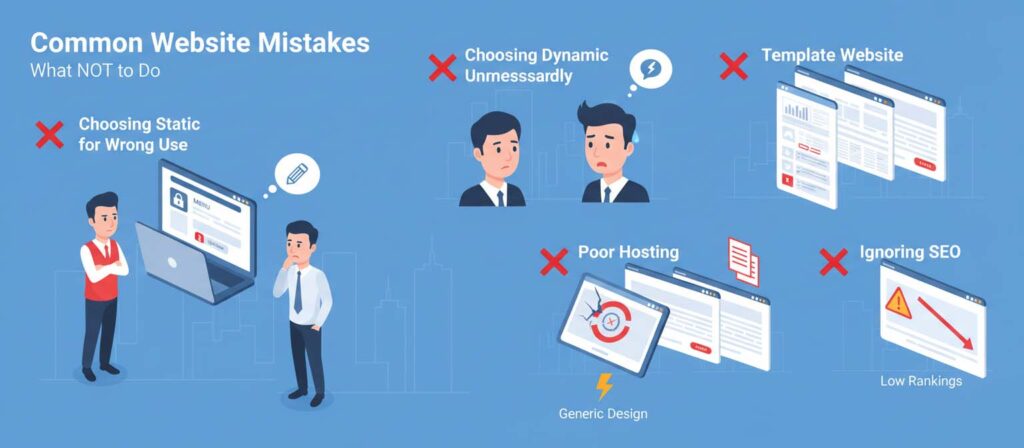
In our years of working with businesses across Mumbai’s commercial landscape, we have seen the same mistakes made repeatedly – mistakes that cost businesses money, time, and commercial opportunity. Here are the most common ones.
This is the most common and most commercially damaging mistake we see. A neighbourhood restaurant that chooses a static website because it costs ₹8,000 less than a dynamic one discovers, six months later, that they cannot update their menu without paying a developer each time, that their website has fallen out of date, that their competitors’ content-rich dynamic websites are outranking them on Google, and that the total cost of the static choice – in developer fees for updates and in lost commercial opportunity – has far exceeded the original saving.
The reverse mistake is less common but still real. An independent professional practitioner who spends significantly more on a complex WordPress website when a well-designed static website would have served their commercial requirements entirely – and would have performed better technically – has invested money in capability they do not need and performance they are not using.
This is Mumbai-specific in its consequences. A WordPress website built on cheap shared hosting – the ₹100 to ₹300 per month hosting packages that cheap website providers use – will be genuinely slow, frequently insecure, and unreliable. In Mumbai’s mobile-heavy traffic environment, where every second of page load time reduces conversion rates and Google search performance, this hosting inadequacy directly translates to lost commercial opportunity. Dynamic websites need to be hosted on adequate infrastructure – managed WordPress hosting or VPS hosting – to perform at the level Mumbai’s market requires.
The Mumbai website development market is full of providers selling template-based WordPress websites – sites built on commercial themes that are available to hundreds of thousands of businesses, that perform poorly, that look generic, and that fail to communicate anything specific or distinctive about the business they are supposed to represent. A templated dynamic website is not a professional website. It is a template with your logo on it. In Mumbai’s competitive market, that distinction has direct commercial consequences.
Whether you are building a static or a dynamic website, the SEO foundations – site structure, URL architecture, page speed, mobile performance, meta tag strategy, internal linking, structured data, Google Search Console configuration – need to be built into the website from the first decision. A website that is beautiful but not SEO-optimized is a commercial tool with no engine. In Mumbai’s intensely competitive search environment, that omission has immediate and sustained commercial costs.
For dynamic websites, the content management capability is only commercially valuable if content is actually being created and managed. Many Mumbai businesses invest in dynamic websites and then never log into the admin panel – never update their blog, never refresh their service pages, never add new case studies or testimonials. The result is a dynamic website that behaves like a static one, without the performance advantages of a well-built static site. Content strategy needs to be planned and resourced from the moment the dynamic website decision is made.
Static vs Dynamic: The Honest Head-to-Head Comparison for Mumbai
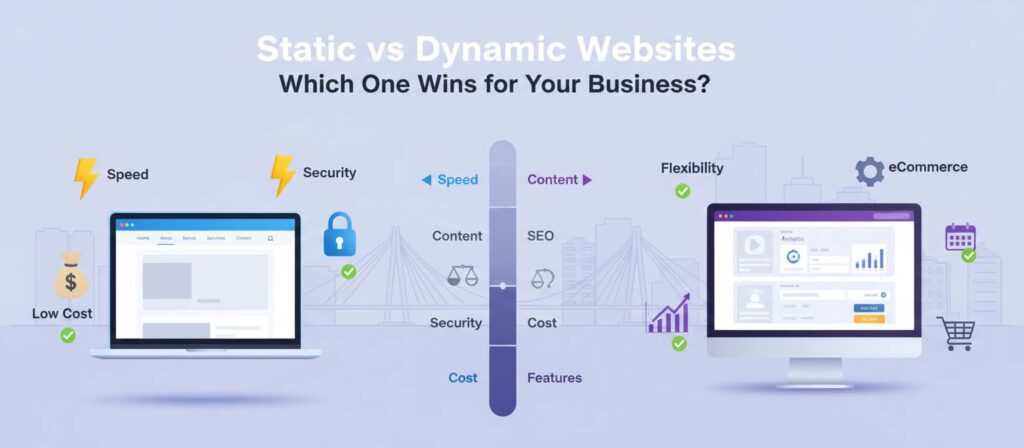
Let us bring this down to the clearest possible summary comparison – calibrated specifically for Mumbai’s commercial context.
Static websites win this category clearly. For Mumbai’s mobile-heavy, varied-connectivity traffic profile, the speed advantage of static is commercially significant. Dynamic websites can close this gap substantially through good technical implementation – managed hosting, caching, CDN deployment, image optimization – but the gap is never fully closed. If your target audience is primarily on mobile, in areas with variable 4G connectivity, and if page speed directly impacts your conversion rates, static’s performance advantage matters.
Dynamic websites win this category without contest. If your business needs to update its website content with any regularity – and most Mumbai businesses do – the content management independence of a dynamic CMS is genuinely valuable and genuinely worth its additional cost.
Both static and dynamic websites can be built with excellent SEO foundations. Dynamic WordPress websites have a meaningful practical advantage in ongoing SEO – because the content publishing capability makes it easier to sustain the active content creation that builds search authority over time. For Mumbai businesses in competitive search categories, this ongoing SEO capability is the decisive factor.
Dynamic websites win this category completely. eCommerce, booking systems, client portals, user accounts, complex forms, personalised experiences – all of these require dynamic development. If your business needs any of this functionality, the static versus dynamic question is already answered.
Static websites win this category. Their minimal attack surface and absence of server-side systems mean they are inherently more secure. Dynamic websites – particularly WordPress – carry real security risks that need to be actively managed. For businesses handling sensitive information, this security advantage of static is commercially important.
Static websites are less expensive to build, host, and maintain. For businesses with straightforward requirements, this cost advantage is real and meaningful. For businesses that need the capability that dynamic websites provide, the additional cost is justified by the commercial return on that capability.
This category is a draw – both static and dynamic websites can be built with genuinely original, brand-specific design. The key variable is not the technology but the approach of the developer. Both template-based static and template-based dynamic websites are commercially inadequate for Mumbai’s competitive market. Both original, custom-designed static and custom-designed dynamic websites can be genuinely excellent.
What Does a Professional Static Website Actually Cost in Mumbai?
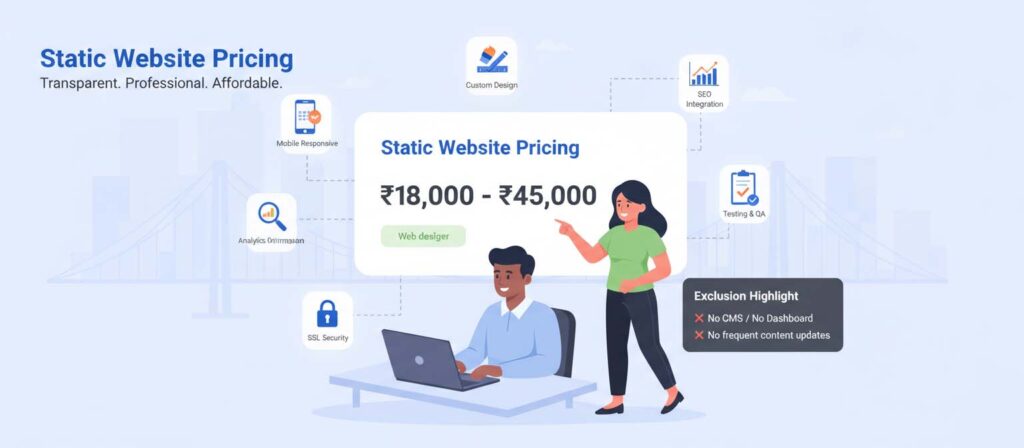
We believe in complete pricing transparency – because the Mumbai web development market is full of providers who quote low to win business and then find ways to add cost later. Here is what professionally built websites actually cost from us.
A professionally designed, custom-coded static website for a Mumbai business – covering a homepage, services pages, about page, team page, and contact page – starts from ₹18,000 and typically falls in the ₹18,000 to ₹45,000 range depending on the number of pages, the design complexity, the content volume, and the specific functional requirements of the business.
This price includes custom design – not a template – built on the client’s brand identity and visual language. It includes mobile responsiveness across all device types and screen sizes. It includes full on-page SEO optimization. It includes Google Analytics and Search Console integration. It includes SSL configuration. It includes comprehensive testing across devices and browsers. And it includes a handover session where we walk the client through everything that has been built.
What it does not include is content management capability – which is why it costs less than a dynamic website. For most of the professional and practitioner businesses for whom static is the right recommendation, that absence is not a limitation.
What Does a Professional Dynamic Website Actually Cost in Mumbai?
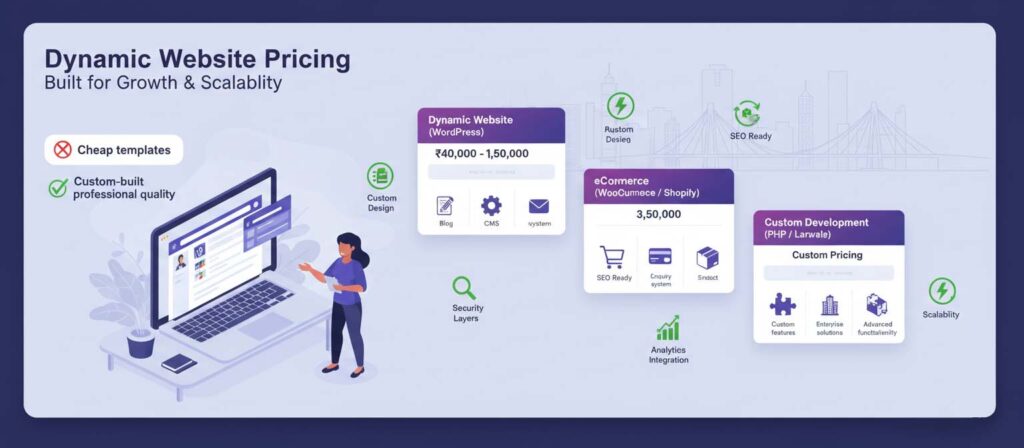
A professionally built, custom-designed WordPress website for a Mumbai business – covering the standard pages plus a blog, a news or updates section, an inquiry management system, and the content management capability to update all of it independently – starts from ₹40,000 and typically falls in the ₹40,000 to ₹1,50,000 range depending on the scope of functionality, the number of pages, the design complexity, and any specific integrations required.
A professionally built WooCommerce or Shopify eCommerce website starts from ₹60,000 and typically falls in the ₹60,000 to ₹3,50,000 range depending on the number of products, the complexity of the product catalogue, the payment gateway integrations required, the shipping and logistics integrations, and any custom functionality beyond the standard eCommerce feature set.
Custom dynamic development on PHP and Laravel – for businesses with requirements that WordPress cannot address – is scoped individually based on the specific functional requirements of each project.
These prices reflect professional, original, custom-built work – not templated shortcuts. They reflect hosting on adequate infrastructure, not shared hosting that will undermine the website’s performance. And they reflect genuine technical quality that will serve the business as a commercial asset for years, not a cheap build that will need to be replaced within eighteen months.
The Vipul Pore and Company Approach to This Decision

When a Mumbai business comes to us and asks whether they need a static or dynamic website, we do not give them a generic answer. We have a conversation.
We ask about the business – what it does, who it serves, where it operates in Mumbai, and what commercial outcomes it needs its website to drive. We ask about the competitive context – who the main competitors are, how they are presenting themselves digitally, and where the gaps are that the website can exploit. We ask about the content plans – whether the business intends to publish a blog, how often the core service or product content changes, whether there is a team member who will manage the website independently after launch.
And then we give an honest recommendation – not the recommendation that generates the most revenue for us, but the recommendation that genuinely serves the business’s commercial needs. Sometimes that recommendation is a beautifully built static website that costs ₹25,000 and performs exactly as the business requires. Sometimes it is a comprehensive custom WordPress build at ₹90,000 that gives the business the content independence, the SEO capability, and the functional depth to compete seriously in Mumbai’s market. Sometimes it is an eCommerce platform with a five-figure investment that is justified by the commercial revenue it will generate.
Whatever the recommendation, it is always grounded in the specific commercial reality of the specific business making the decision – in Mumbai, with all the complexity, competition, and opportunity that entails.
We also bring our branding and graphic design services into the conversation from the beginning – because the best website in the world underperforms if the brand identity behind it is unclear or inconsistent. For businesses building or refreshing their brand alongside their website, we can do both under one roof.
And once the website is live, we offer the ongoing SEO support, content strategy, and digital partnership that transforms a well-built website into a compounding commercial asset – one that grows in search authority, in organic traffic, and in commercial return over time. You can explore how we work on our development process page, and you can read what our clients say about working with us on our client reviews page.
The Bottom Line
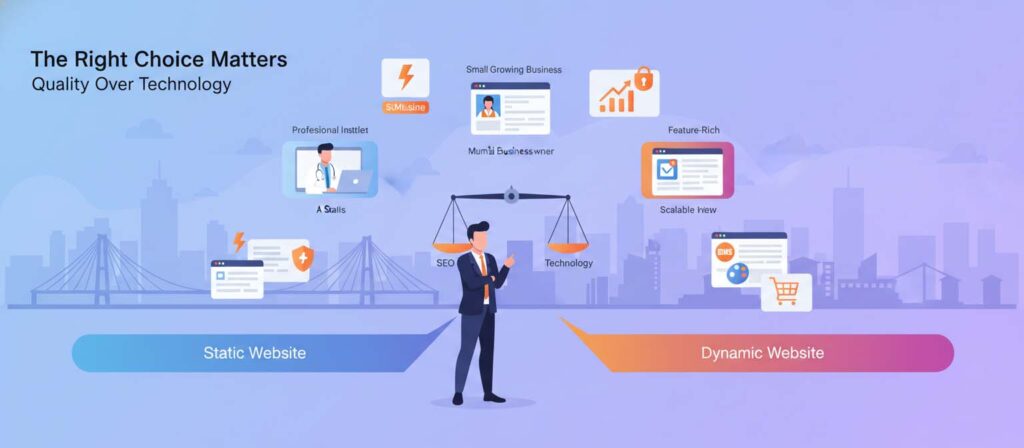
Here it is, as simply as we can put it.
If you are an independent professional or practitioner in Mumbai – a doctor, lawyer, accountant, architect, or specialist – whose website is essentially a credibility-building, contact-generating tool that will not need frequent content updates: a professionally built static website is probably the right choice, and it will serve you excellently at a price point that is appropriate for your requirements.
If you are a business in Mumbai that needs to update your website content regularly, publish a blog, manage a product catalogue, run an online store, or grow your organic search presence through active content creation: a professionally built dynamic website is the right choice, and the investment is justified by the commercial capability and competitive advantage it provides.
If you are building an eCommerce business in Mumbai, regardless of size: a professionally built eCommerce platform is not optional – it is the foundation of your commercial model, and under-investing in it is one of the most commercially costly mistakes you can make.
And in every case – static or dynamic, practitioner or enterprise, eCommerce or professional services – the most important variable is not the technology. It is the quality of the build. A well-built static website outperforms a poorly-built dynamic one in every commercial metric. A custom-designed, SEO-optimized, performance-tuned website of either type will generate better commercial returns than a templated, poorly-hosted, SEO-neglected website of the same type.
Mumbai’s market does not reward half-measures. Invest in the right type of website, built to the right standard, by people who understand this city’s commercial reality – and it will return that investment many times over.
Ready to Make the Right Decision for Your Mumbai Business?

We are Vipul Pore and Company – a web development company based in Borivali West, Mumbai, serving businesses across the city’s full commercial geography. We build static and dynamic websites, eCommerce platforms, and custom web applications for Mumbai businesses across every suburb, every industry, and every stage of commercial development.
If you have read this far and you are still not sure which type of website is right for your business – contact us today for a free consultation. We will have an honest conversation about your business, your market, and your requirements – and give you a clear, specific recommendation with no obligation and no pressure.
If you already know what you need and you want to talk about building it – contact us today and let us get started.