
Why Choosing the Right Website Development Company Matters
Choosing a website development company is an important business decision because the website can become one of the company’s most important digital assets.
A website is not simply a collection of pages.
It can support:
- Brand presentation
- Lead generation
- E-commerce
- Customer communication
- Search visibility
- Digital marketing
- Online bookings
- Product sales
- Business automation
The company you hire can influence how effectively these objectives are achieved.
A low-cost website may appear attractive initially, but businesses should understand exactly what is included before comparing quotations. On the other hand, a high-priced proposal is not automatically better simply because it comes from a larger agency.
The important question is:
Does the development company understand your business requirements and have the capabilities needed to build, launch and support the website successfully?
The Mumbai market illustrates why this comparison can be difficult. Current 2026 published pricing examples range from relatively small business websites costing tens of thousands of rupees to complex e-commerce and custom applications costing several lakhs or more. The variation is largely driven by scope, functionality, technology, design, integrations and support requirements.
A good development partner should therefore be evaluated on scope, capability, communication, process and long-term value, not just the initial quotation.
Define Your Website Requirements Before Contacting a Development Company
Before approaching a website development company, clearly define what you want the website to achieve.
You do not need a complete technical specification.
However, you should have a basic understanding of your business requirements.
Start by asking:
What is the primary purpose of the website?
For example:
- Generate leads
- Sell products
- Showcase services
- Build brand credibility
- Generate appointments
- Publish content
- Create an online catalogue
- Provide customer accounts
Then identify your target audience.
A website for a manufacturing company may need detailed product and technical information.
A restaurant may need menus, location information and reservations.
A professional service company may focus on lead generation and credibility.
An e-commerce business may need product discovery, checkout, payments and shipping.
Create a Basic Requirement Checklist
Before requesting quotations, identify:
- Website type
- Approximate number of pages
- Required features
- Preferred platform, if known
- Existing website
- Content availability
- Product or service information
- Third-party integrations
You do not need to decide every technical detail yourself.
A good development company should help translate your business requirements into a practical technical solution.
The clearer your initial requirements are, the easier it becomes to compare proposals from different companies.
Check the Company's Experience and Technical Expertise
Experience should be evaluated based on relevant experience, not simply the number of years a company claims to have existed.
A development company may have extensive experience building one type of website but limited experience with the functionality your business requires.
For example, building a basic brochure website is different from developing:
- A large WooCommerce store
- A Shopify store
- A membership platform
- A booking system
- A customer portal
- A learning management system
- A custom web application
Ask the company about projects similar to yours.
Areas to Evaluate
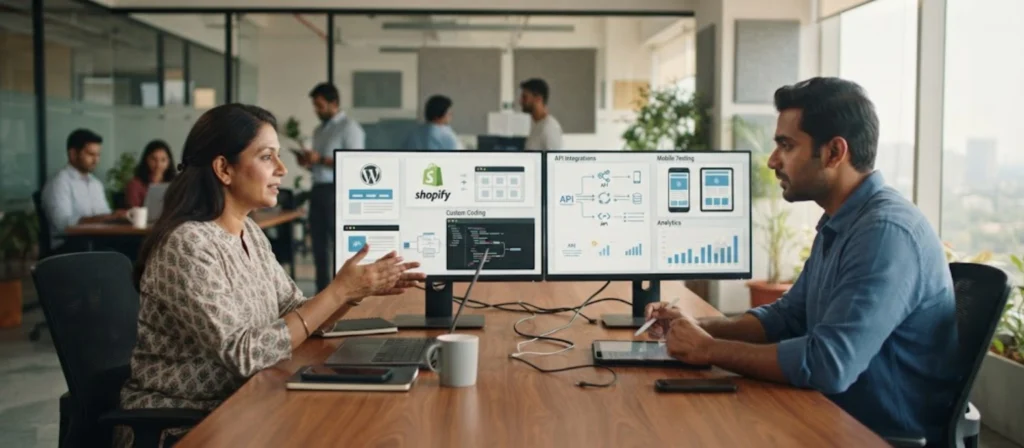
Platform Expertise
Does the team work with the platform you need?
Development Skills
Can they handle custom functionality when required?
UI/UX
Do they understand how users will navigate and interact with the website?
SEO
Can they build an SEO-friendly technical foundation?
Performance
Do they consider loading speed, mobile performance and Core Web Vitals?
Security
Do they follow appropriate security and update practices?
Integrations
Can they connect your website with CRMs, payment gateways, APIs, analytics or other business systems?
Maintenance
Can they support the website after launch?
Google’s current guidance encourages website owners to consider overall page experience, including Core Web Vitals, mobile presentation, secure delivery and intrusive-interstitial practices.
Therefore, technical capability should extend beyond simply making the website look attractive.
Evaluate the Company's Portfolio Carefully
A portfolio is one of the most useful resources when comparing website development companies.
However, do not judge a portfolio only by how attractive the screenshots look.
Look for evidence that the company can solve problems similar to yours.
What to Look for in a Portfolio
Industry Relevance
Has the company worked with businesses similar to yours?
Website Complexity
Have they built websites with similar functionality?
Responsive Design
Check the examples on both desktop and mobile.
Navigation
Can you understand how the websites are structured?
User Experience
Does the website make it easy to find important information?
Performance
Check how quickly portfolio examples load.
Content Structure
Look at how services, products and information are presented.
Conversion Elements
Check forms, CTAs, enquiry paths and purchase journeys.
Technical Quality
Test some live examples rather than relying only on screenshots.
A portfolio screenshot can look impressive even when the actual website experience is not.
Whenever possible, visit the live website and test it yourself.
Also ask the development company which parts of the project they handled.
Some agencies display work where they only handled a small part of the project.
Understanding their actual contribution gives you a more accurate picture of their capabilities.
Make Sure They Recommend the Right Technology for Your Business
A professional website development company should recommend technology based on your requirements rather than simply promoting the platform they use most often.
Different platforms solve different problems.
WordPress
WordPress can be suitable for businesses that need flexible content management, publishing capabilities and a large ecosystem.
Shopify
Shopify can be suitable for businesses looking for a hosted e-commerce platform with commerce functionality.
WooCommerce
WooCommerce can be appropriate for businesses that want to build an online store around WordPress.
Custom Development
Custom development may be appropriate when the website requires specialized functionality, complex integrations or business logic that standard platforms cannot efficiently handle.
Compare Website Development Quotes Based on Scope, Not Just Price
One of the biggest mistakes businesses make is comparing only the final number on different quotations.
Two companies can quote ₹50,000 and ₹1,50,000 for what appears to be “the same website” while actually offering very different scopes.
A lower quote may exclude:
- Custom UI/UX
- Content writing
- SEO setup
- Mobile optimization
- Analytics
- Integrations
- Testing
- Security
Current Mumbai pricing references demonstrate substantial variation between basic business websites, professional websites, e-commerce stores and custom applications. For example, published 2026 estimates range from roughly ₹20,000–₹60,000 for business sites to ₹1.5 lakh–₹5 lakh+ for custom or enterprise projects, depending on scope. These should be treated as market reference ranges rather than fixed prices.
Ask About the Website Development Process
A professional development company should be able to explain how a project moves from initial discussion to launch.
The exact process will vary, but it should generally include clear stages.
A Typical Website Development Process
1. Discovery
The team understands the business, audience, goals and requirements.
2. Planning
The sitemap, functionality and technical approach are established.
3. Wireframing
The structure of key pages is planned.
4. UI/UX Design
Visual design and user experience are developed.
5. Development
The approved design is converted into a working website.
6. Content Integration
Text, images, products and other content are added.
7. Integrations
APIs, CRMs, payments, analytics and other required systems are connected.
8. Testing
The website is checked across relevant browsers, devices and user journeys.
9. Launch
The website is deployed to the live environment.
10. Post-Launch Support
Technical problems and launch-related issues are addressed.
Ask who is responsible for approvals at each stage.
Check Their Approach to SEO, Speed and User Experience
Website development and SEO should not operate as completely separate activities.
Technical choices can influence how easily search engines crawl, understand and access a website.
Google’s Search Central resources cover technical requirements, Search Console, SEO fundamentals and ways to improve how websites perform in Search.
Before hiring a company, ask whether SEO is considered during development.
Important Areas to Discuss
URL Structure
Are URLs descriptive and logically organized?
Mobile Experience
Does the website work effectively across mobile devices?
Page Performance
How will images, scripts, fonts and other resources be optimized?
Internal Linking
Will related pages be connected logically?
Metadata
Can page titles and descriptions be managed properly?
Sitemap
Will an XML sitemap be created and maintained?
Indexing
Will robots.txt and indexing controls be configured correctly?
Structured Data
Can relevant structured data be implemented where appropriate?
Analytics
Will analytics and conversion tracking be configured?
Search Console
Will the website be connected to Google Search Console?
User Experience
Will navigation, forms and important user journeys be tested?
Google’s documentation states that good page experience includes factors such as Core Web Vitals, secure pages, mobile usability and avoiding intrusive experiences, while also noting that there is no single “page experience signal.”
The development company should therefore focus on the complete user experience rather than chasing one technical score.
Ask About Security, Testing and Website Ownership
Security and ownership are often overlooked when businesses select a development company.
Before signing a contract, clarify who controls the important website assets.
This can include:
- Domain
- Hosting
- Website files
- Database
- CMS account
- Plugins and themes
- Shopify account
- Analytics
- Google Search Console
Ideally, business-critical accounts should not be controlled exclusively by the development company.
Ask how access will be handled and what happens if you decide to change providers in the future
Conclusion: Choose a Website Development Partner, Not Just a Vendor
Choosing the right website development company is about much more than finding someone who can build web pages.
The right company should understand your business objectives, recommend appropriate technology, create a good user experience, consider SEO and performance, communicate clearly and provide a realistic path from planning to launch.
Before hiring, define your requirements and compare companies based on:
- Relevant experience
- Portfolio
- Technology expertise
- UI/UX capability
- SEO knowledge
- Performance
- Security
- Project process
- Communication
- Pricing
- Ownership
- Post-launch support
Do not select a company purely because it has the lowest price or the most impressive-looking homepage.
Likewise, do not assume that a large quotation automatically represents better quality.
Current Mumbai pricing references demonstrate how widely website development costs can vary depending on the type of website, features, technology, integrations and level of service.
A website is a long-term business asset. The development company you choose should therefore be capable of helping you build something that works today and can evolve as your business grows.
For businesses searching for a website development company in Mumbai, the best starting point is a clear project brief, a transparent scope and a detailed comparison of what each provider actually offers.