
Customer Data Platform Integration for Businesses: Unify Customer Information Across Marketing and Sales Channels
Customers interact with businesses through multiple channels before making a purchase. They may discover a brand through social media, visit its website, subscribe to an email newsletter, contact the sales team and eventually complete an order through an e-commerce store. Each interaction creates useful customer information, but this data often remains separated across different platforms.
This makes it difficult for businesses to understand the complete customer journey. Marketing teams may not know which customers have already purchased, while sales representatives may lack information about previous website enquiries or campaign interactions.
Customer Data Platform (CDP) integration for businesses helps address this challenge by collecting customer information from different sources, organising it and connecting relevant records into unified customer profiles. These profiles can then support marketing campaigns, sales activities, customer service and personalised digital experiences.
By integrating a CDP with existing business systems, companies can reduce data silos, improve customer understanding and make better use of the information they already collect
1. Understanding Customer Data Platforms
A Customer Data Platform is a system designed to collect and unify customer information from multiple sources. It creates organised customer profiles that authorised business systems and teams can use for analysis, segmentation and customer engagement.
For example, a customer might visit an online store, view three products, subscribe to promotional emails and later place an order. Without connected systems, these interactions may appear as separate records. A CDP can help associate relevant information with the same customer profile when reliable identifiers and appropriate permissions are available.
A CDP may collect behavioural information, purchase history, customer preferences, contact details and engagement activity. It can also receive information from CRM software, mobile applications, point-of-sale systems and customer support platforms.
The objective is not simply to store more data. It is to make existing customer information more consistent, accessible and useful. A unified profile can help a marketing team understand customer interests while allowing a sales representative to view relevant interactions before contacting a potential buyer.
The exact capabilities depend on the selected platform, integration architecture, identity-matching rules and data governance policies.
2. Important Data Sources to Connect with a CDP
A CDP becomes more useful when it receives relevant information from the systems customers interact with throughout their journey. Businesses should identify which sources provide meaningful data and determine how frequently that information needs to be updated.
Common data sources include:
- Business websites: Capture page views, product interactions, form submissions and other permitted website activities.
- E-commerce platforms: Provide product views, shopping cart activity, purchases, refunds and order history.
- CRM systems: Supply contact details, sales enquiries, customer records and opportunity information.
- Email marketing platforms: Share subscription status, campaign engagement and communication preferences.
- Mobile applications: Provide app activity, account interactions and relevant engagement events.
- Customer support systems: Connect service requests, complaints, feedback and support history.
- Point-of-sale systems: Add information about eligible in-store transactions and customer purchases.
- Advertising platforms: Receive or activate permitted audience and campaign information according to platform requirements and consent.
For example, a retail business may connect its website, Shopify store, email marketing platform and CRM. A service company may prioritise website forms, appointment bookings, sales enquiries and customer support records.
Not every business needs to connect every system immediately. Starting with the most valuable sources makes implementation easier to manage and helps establish a reliable data foundation.
3. How Identity Resolution Creates Unified Customer Profiles
One of the most important capabilities of a CDP is identity resolution. Customers may interact with a business through different devices, browsers, accounts and communication channels. As a result, the same person can appear as several separate records across business systems.
Identity resolution uses available identifiers and matching rules to determine whether different records are likely to belong to the same customer. These identifiers may include verified email addresses, authenticated account IDs, customer numbers or mobile numbers, depending on the platform and applicable permissions.
Consider a customer who first visits a website anonymously and later creates an account. The CDP may be able to associate earlier activity with the authenticated profile if the platform supports the relevant matching process and the required privacy conditions are satisfied.
However, identity matching must be handled carefully. Two people may share a device, phone number or household email address. Incorrectly merging their records can create inaccurate profiles and inappropriate marketing activity.
Businesses should define reliable matching rules, confidence levels and processes for resolving conflicting records. They should also preserve distinctions between known and anonymous activity when a connection cannot be established confidently.
A unified profile should represent the information that can be responsibly linked to a customer, not an assumption that every interaction belongs to the same person.
4. Key Benefits of CDP Integration for Marketing and Sales
Connecting customer information across business systems can improve coordination between teams. Instead of relying on disconnected reports and spreadsheets, authorised employees can use more consistent customer information to support their work.
Important business benefits include:
- Better customer understanding: Bring relevant purchase, engagement and enquiry information together to understand customer behaviour.
- More relevant marketing campaigns: Create audience segments based on permitted customer attributes and interactions.
- Improved sales preparation: Help sales representatives understand previous enquiries and relevant engagement before contacting prospects.
- Reduced duplicate records: Identify and manage repeated customer entries across connected systems.
- Consistent customer communication: Reduce situations where customers receive irrelevant messages after completing a purchase or requesting support.
- Improved customer retention: Identify suitable opportunities for follow-ups, service communication and repeat-purchase campaigns.
- More useful reporting: Analyse customer journeys using connected information from multiple channels.
- Better team coordination: Give authorised marketing, sales and service teams access to relevant customer insights.
For example, an e-commerce company can use purchase information to exclude recent buyers from an acquisition campaign and include eligible customers in a post-purchase communication journey.
These benefits depend on data quality, integration reliability and the ability of teams to use the information appropriately. A CDP does not automatically improve business results simply because multiple systems are connected.
5. CDP Integration with CRM, E-commerce and Marketing Automation
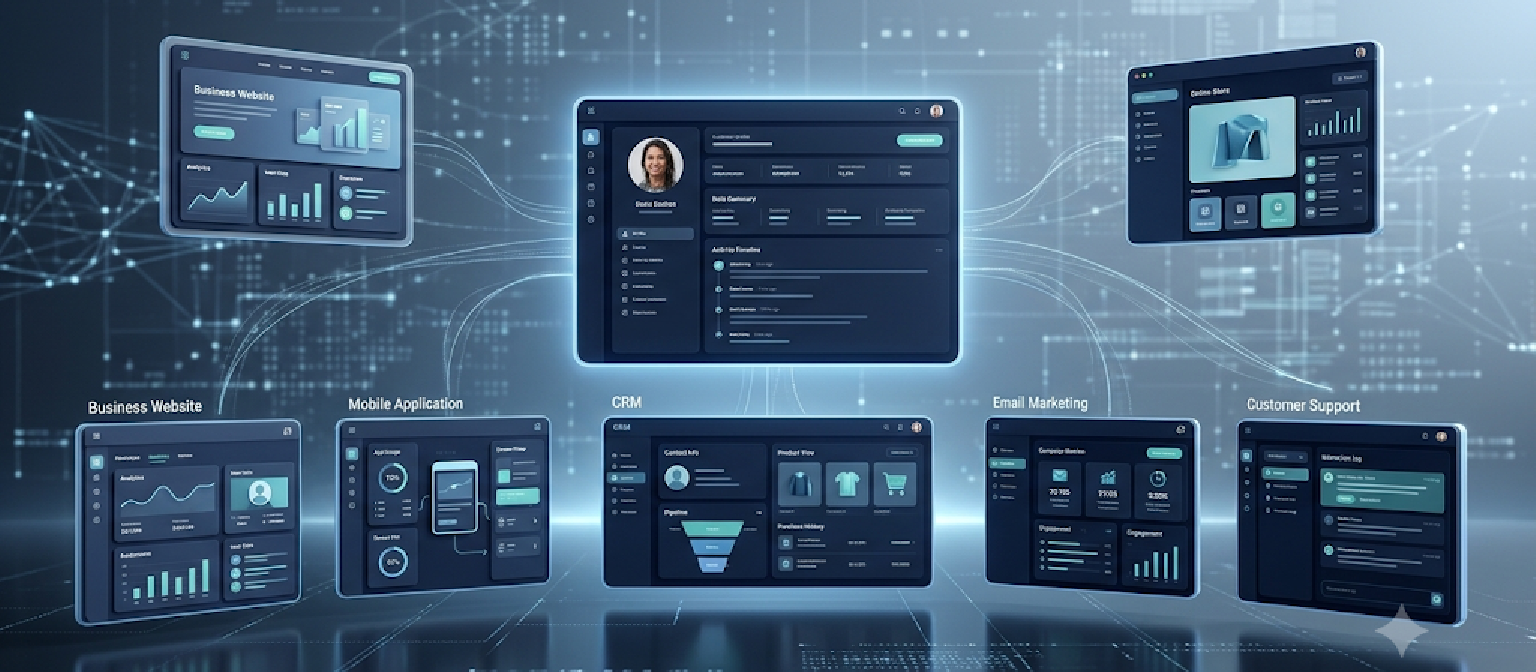
A CDP should work alongside existing business software rather than unnecessarily replacing every system. CRM, e-commerce platforms and marketing automation tools usually have different responsibilities, and integration allows them to exchange relevant information.
A CRM generally supports sales activities such as lead management, customer communication, opportunity tracking and follow-ups. An e-commerce platform manages product information, carts, orders and payments. Marketing automation tools manage campaigns, subscriptions and communication workflows.
The CDP can receive selected information from these systems, unify relevant customer records and send appropriate segments or profile attributes to connected destinations.
For example, when an e-commerce customer completes an order, the transaction information may be sent to the CDP. The unified profile can then be updated and relevant purchase information made available to an approved marketing system or CRM.
Businesses should define which platform owns each important record. The e-commerce system may remain the source of truth for order status, while the CRM manages sales opportunities and the CDP maintains unified customer profiles.
This avoids confusion when different systems contain conflicting information. It also helps prevent unnecessary duplication and uncontrolled updates between connected applications.
6. Real-Time Data Synchronisation and Integration Methods
Customer information becomes more useful when updates reach connected systems at the appropriate time. A CDP integration should therefore define how data is collected, processed and shared.
Different integration methods can support different business requirements:
- API integration: Connect applications through defined endpoints to exchange customer records, events and profile information.
- Webhook integration: Send event notifications when a relevant activity occurs, such as a purchase or form submission.
- Batch data imports: Transfer records at scheduled intervals when immediate updates are not necessary.
- Event tracking: Capture permitted website or app activities through suitable tracking implementations.
- Database integration: Import or exchange selected records from business databases through controlled processes.
- Pre-built connectors: Use supported integrations to connect commonly used CRM, e-commerce and marketing platforms.
- Custom connectors: Develop integrations for internal applications or systems without suitable ready-made connectors.
For example, a business may send purchase events to its CDP through an API or event stream while importing older customer records through a scheduled batch process.
The integration architecture should account for failed requests, duplicate events, delayed updates and changes to application APIs. Retry mechanisms and event identifiers can help prevent information from being lost or processed more than once.
Not every activity requires real-time processing. A high-priority purchase or customer service event may need rapid synchronisation, while historical reporting data can often be transferred in scheduled batches.
7. Customer Segmentation and Personalised Marketing
Once customer information is organised into unified profiles, businesses can create segments based on relevant attributes and interactions. These segments help marketing teams deliver more suitable communication to different customer groups.
For example, an online fashion store may create separate segments for first-time buyers, repeat customers, customers interested in a particular product category and shoppers who have abandoned eligible shopping carts.
A CDP can help update these segments as new information becomes available. A customer who completes a purchase may move from a prospect segment into a customer segment, subject to the business’s defined rules.
Segmentation can support several activities, including personalised email campaigns, product recommendations, customer retention programmes and targeted promotional communication.
However, personalisation should be based on relevant information and appropriate customer permissions. Businesses should avoid collecting unnecessary personal details or using sensitive attributes without a lawful and clearly defined purpose.
Campaign teams should also monitor whether personalisation improves meaningful outcomes. Higher engagement does not always translate into better customer satisfaction or increased profitability.
8. Data Quality, Privacy and Customer Consent Management
A unified customer profile is only useful when the underlying information is accurate, relevant and responsibly managed. Poor data quality can lead to duplicate profiles, incorrect customer matching, outdated contact details and unsuitable marketing communication.
Businesses should establish data governance rules before connecting large numbers of systems. These rules should define which data can be collected, how it is validated, who can access it and how long it should be retained.
Privacy and consent management should be part of the integration design rather than an afterthought. Customer communication preferences and applicable permissions need to be respected when data is collected, combined or shared with other platforms.
Important governance practices include:
- Data validation: Check required fields, formats and values before accepting records.
- Duplicate management: Identify repeated records and apply controlled merging rules.
- Consent tracking: Store relevant communication preferences and permission status.
- Access control: Restrict customer information according to employee responsibilities.
- Data retention: Define how long different categories of customer information should be stored.
- Data correction: Provide suitable processes for handling inaccurate or outdated records.
- Audit records: Maintain appropriate logs of important data access and processing activities.
For businesses operating in India, customer data handling should be planned with applicable legal requirements in mind, including relevant obligations under the Digital Personal Data Protection Act and associated rules as they apply.
A CDP can help centralise certain privacy controls, but using one does not automatically make an organisation compliant. Businesses should obtain appropriate legal and security guidance for their specific operations.
9. Measuring CDP Integration Performance

After implementation, businesses should evaluate whether the CDP is improving data quality, operational efficiency and customer engagement. Measuring only the number of connected systems does not provide enough insight into whether the platform is delivering value.
Useful performance indicators include:
- Profile completeness: Measure how much relevant customer information is available in unified profiles.
- Duplicate record rate: Track the number of repeated or incorrectly separated customer records.
- Data synchronisation delay: Monitor how quickly important events and profile changes reach connected systems.
- Identity match quality: Evaluate whether matching rules create reliable customer profiles.
- Segment accuracy: Check whether customers are assigned to the appropriate marketing or sales groups.
- Campaign performance: Compare engagement, conversions and revenue across relevant audience segments.
- Lead-to-customer conversion: Assess whether connected customer insights support better sales outcomes.
- Integration reliability: Monitor failed events, API errors and incomplete data transfers.
For example, a business can compare the number of duplicate leads before and after CRM integration. It can also measure whether sales representatives spend less time searching for customer information.
Performance reviews should include both technical and business indicators. A platform may process millions of events successfully but still provide limited value if the resulting profiles do not support meaningful business decisions.
10. Planning and Developing a CDP Integration Strategy
A successful CDP project should begin with business objectives rather than selecting software based only on its feature list. Companies should identify the customer information they need, the teams that will use it and the business processes they want to improve.
The first stage is auditing existing systems and understanding where customer information is currently stored. The business should identify duplicate records, missing fields, inconsistent identifiers and existing integration limitations.
Next, the team should define the data model, identity resolution rules, privacy requirements and integration priorities. A smaller initial implementation may connect the website, CRM and e-commerce platform before expanding to advertising, support and offline systems.
Platform selection should consider connector availability, API flexibility, data processing requirements, scalability, security controls and ongoing costs. Businesses should also evaluate whether their internal teams can manage the platform or require specialist development support.
The implementation process generally includes requirements analysis, architecture planning, connector development, data mapping, testing and deployment. Testing should cover duplicate events, incorrect identifiers, consent changes, failed synchronisation and conflicting customer records.
After launch, the organisation should monitor data quality, integration performance and user adoption. Documentation and employee training are important because teams need to understand how unified profiles are created and how customer information should be used.
A phased approach allows businesses to establish a reliable foundation before introducing more advanced personalisation and automation features.
Conclusion
Customer Data Platform integration helps businesses connect customer information across websites, e-commerce platforms, CRM systems, marketing applications and other communication channels. By combining relevant data into unified profiles, organisations can gain a clearer understanding of customer interactions and improve coordination between marketing, sales and customer service teams.
Successful implementation requires more than connecting software. Businesses need reliable identity resolution, accurate data mapping, secure integrations, consent management and ongoing performance monitoring.
A well-planned CDP strategy can begin with a few essential systems and expand as business requirements grow. When supported by clear data governance and practical business objectives, CDP integration can create a stronger foundation for personalised customer experiences, informed decisions and long-term customer relationships.