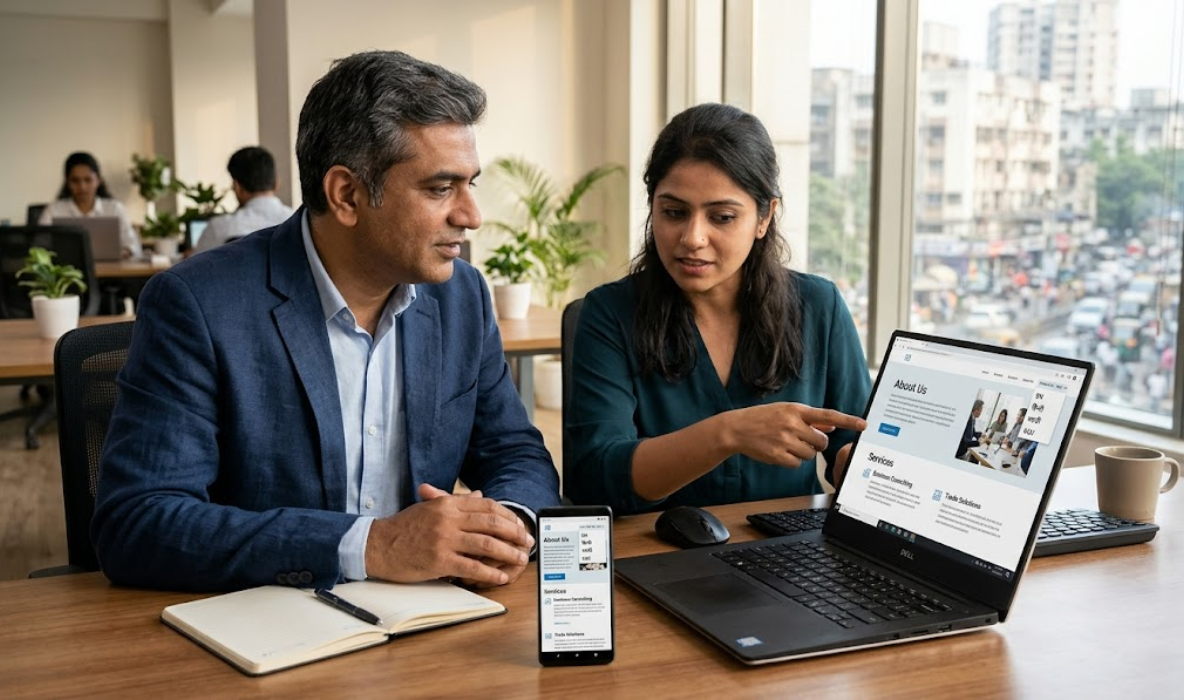
Introduction: Why Mumbai Businesses Need Multilingual Websites
Mumbai is one of India’s most diverse business markets. From local retailers and restaurants to real estate companies, professional service providers, educational institutes, and online stores, businesses serve customers with different languages and communication preferences.
Although English is widely used in business, many customers feel more comfortable exploring services, comparing products, and contacting companies in Marathi or Hindi. A website that communicates only in English may unintentionally make some visitors feel that the business is not designed for them.
A multilingual website allows visitors to select a language they understand and explore the business more confidently. It can make service information easier to understand, improve the browsing experience, and help businesses communicate with a wider audience.
For businesses targeting Mumbai customers, Multilingual Website Development Mumbai is not simply about translating website text. It involves creating a website that reflects the language preferences, cultural context, and search behaviour of the intended audience.
What Is a Multilingual Business Website?
A multilingual business website is a website that provides its content in two or more languages. Visitors can select their preferred language and access important information in a format they can understand.
For example, a Mumbai-based business website may offer:
- English content for customers who prefer professional business communication.
- Marathi content for customers who prefer the local language.
- Hindi content for customers who are more comfortable communicating in Hindi.
- Additional languages when the business serves specific communities or international customers.
The website should not simply display translated words. Its navigation, buttons, forms, product information, service descriptions, and important customer instructions should also be available in the selected language.
Identify the Languages Your Mumbai Customers Actually Use
Before developing a multilingual website, a business should understand its audience. Adding every possible language may increase translation costs and maintenance work without providing meaningful benefits.
The right language selection depends on the business location, target customers, services, and customer communication patterns.
For a Mumbai-focused business, English, Marathi, and Hindi can be useful starting points. However, the final decision should be based on actual customer requirements rather than assumptions.
A business serving customers in Borivali, Kandivali, and Malad may have different language priorities from a company serving corporate clients across Mumbai.
Start with the languages that provide the greatest value to your audience. Additional languages can be introduced as the business expands.
Plan the Website Structure Before Translating Content
A multilingual website requires a clear structure. Each language should have a predictable location, and visitors should be able to move between language versions easily.
Before development, plan the following:
- Which pages will be available in every language?
- Will the homepage have separate language versions?
- Will service pages be translated individually?
- How will the language selector work?
- What happens when a page is not yet translated?
- How will the website maintain links between corresponding language pages?
Avoid sending every language selection to the translated homepage. If a visitor is viewing a particular service page, the language switcher should ideally open the equivalent page in the selected language.
Choose the Right Technology for Multilingual Website Development
The technology used to build a multilingual website affects its performance, flexibility, maintenance, and future expansion.
Businesses using WordPress can choose from several multilingual solutions. The best option depends on the website’s size, content requirements, budget, and technical setup.
A multilingual plugin can help manage translations, language-specific URLs, navigation, and other website elements. However, installing a plugin alone does not guarantee that the website will be properly translated or optimised.
For businesses using Elementor, compatibility should be checked before choosing a multilingual plugin. Templates, menus, forms, popups, and dynamic content may require separate configuration.
A professional WordPress developer can help select a solution that fits the existing website rather than adding unnecessary complexity.
Translate Website Content Accurately and Naturally
Translation is one of the most important parts of multilingual website development. Poorly translated content can confuse customers, weaken trust, and make a professional business appear careless.
A practical translation process includes:
- Create a content inventory: List every page, menu, button, form, and important message.
- Prepare a glossary: Maintain consistent translations for business terms, service names, and technical phrases.
- Use qualified translators: Have important content reviewed by someone fluent in the target language.
- Preserve the brand voice: Keep the business tone consistent across all languages.
- Review cultural context: Make sure examples, expressions, and communication styles suit the intended audience.
- Test the final content: Check translated text on desktop and mobile layouts.
For high-value pages such as service descriptions, pricing information, legal notices, and enquiry forms, accurate translation is especially important.
Optimise Every Language Version for Search Engines
A multilingual website can help a business reach customers who search in different languages. However, search engines need clear signals to understand which page belongs to which language and audience.
Simply translating a page does not automatically improve its search rankings. Each language version should have useful content, a clear URL, and appropriate technical SEO settings.
For example, a Mumbai business may have an English service page and a Marathi equivalent. These pages should be connected appropriately rather than treated as unrelated pages.
Keyword research should also be conducted separately for each language. Customers may use different expressions when searching in Marathi, Hindi, or English, even when they are looking for the same service.

Design a Simple and Accessible Language Switcher
A language switcher allows visitors to change the website’s language. It should be easy to find, understand, and use.
If customers cannot locate the language option, they may leave the website before exploring its services. The switcher should therefore be included in a consistent location across the website.
Use clear language names such as English, मराठी, and हिन्दी. Avoid relying only on national flags because a flag does not always represent a language accurately.
The switcher should also work properly on mobile devices. A small dropdown may be suitable for desktop navigation, while a clearly labelled option inside the mobile menu can provide a better experience on smaller screens.
Make the Website Responsive Across Devices
A multilingual website must work smoothly on desktop computers, tablets, and smartphones. This is particularly important because customers may discover a business through mobile search, social media, messaging apps, or local listings.
Responsive multilingual design should consider:
- Flexible layouts: Allow sections to adapt to longer text.
- Readable typography: Use fonts that support the required scripts.
- Navigation spacing: Prevent translated menu items from overlapping.
- Button sizing: Ensure translated calls to action remain easy to tap.
- Form labels: Keep translated labels and validation messages clear.
- Mobile language selection: Make language controls accessible without excessive scrolling.
A website should not look polished in English but broken in Marathi or Hindi. Each language version deserves the same design quality and testing.
Conclusion: Build a Website That Speaks to Your Customers
A multilingual website can help Mumbai businesses communicate more effectively with customers who prefer different languages. It can make service information easier to understand, improve navigation, and provide a more inclusive online experience.
However, successful multilingual website development requires more than translating a few pages. Businesses need a clear language strategy, accurate translations, search-friendly URLs, a simple language switcher, responsive layouts, and ongoing maintenance.
The most effective approach is to begin with the languages your customers actually use. Build a consistent website structure, translate important pages carefully, and test the experience across devices before expanding further.
For businesses planning Multilingual Website Development Mumbai, a professionally developed WordPress website can provide the flexibility to manage multiple languages while maintaining performance, usability, and search visibility.